What is vapour pressure deficit (VPD)?
On every warm, dry day a tree loses water through its leaves. How hard the air pulls that water outward is captured in a single number: the vapour pressure deficit, internationally known as VPD (Vapour Pressure Deficit). It does not tell you what the tree is doing, but why the tension rises — and that makes it a key to understanding water stress.
Transpiration: how a plant loses water
A plant breathes through microscopic openings in the leaf, the stomata. Through them it takes in CO₂ for photosynthesis, but at the same time it loses water vapour — this is what we call transpiration. That loss draws water upward, as if through a long straw: from the roots, through the trunk, into the leaves. That uninterrupted transpiration stream is also the transport by which the tree carries water and dissolved nutrients upward.
Transpiration is therefore not merely loss — it keeps the water column moving and cools the leaf. But it comes at a price: as long as the stomata stay open to let CO₂ in, water escapes. If that loss becomes too great, the plant partly closes its stomata, and CO₂ uptake — and thus growth — stalls along with it.
How strong transpiration is depends on the environment. Four factors drive it:
- Radiation (sunlight) supplies the energy to evaporate water and triggers photosynthesis, which opens the stomata. More light usually means more transpiration.
- Temperature determines how much moisture the air can hold: warm air “pulls” harder at the leaf water than cool air.
- Humidity works the other way around: humid air already holds a lot of water vapour, so transpiration proceeds more slowly; dry air speeds it up.
- Wind carries away the humid layer of air right around the leaf and replaces it with drier air, increasing water loss.
It is precisely that combined “demand from the air” — above all the combination of temperature and humidity — that is captured in the vapour pressure deficit.
What is the vapour pressure deficit (VPD)?
The vapour pressure deficit expresses how “thirsty” the air is: the difference between how much water vapour the air could maximally hold and how much it actually holds at that moment. If that difference is large, the air pulls hard at the water in the plant.
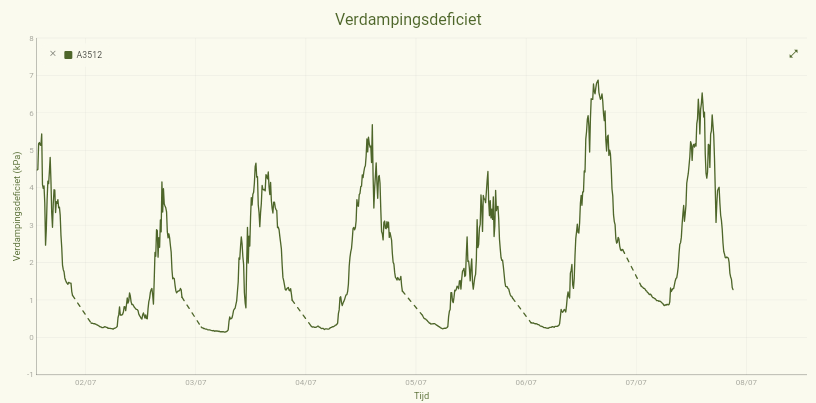
You calculate it from the temperature and the relative humidity — not from the trunk. The unit is kPa (kilopascal, a pressure unit). An important detail: warm air can hold much more moisture than cold air. As a result the VPD rises at the same humidity simply by increasing the temperature. The VPD therefore follows the temperature closely: at night it is almost zero, during the day it peaks.
How do you calculate the VPD?
The VPD is the difference between the saturation vapour pressure (how much vapour the air can hold at that temperature) and the actual vapour pressure (how much is in it now). That actual vapour pressure is simply the saturation vapour pressure times the relative humidity. Hence:
VPD = es(T) × (1 − RH / 100)
where RH is the relative humidity in % and es(T) is the saturation vapour pressure at temperature T. That saturation vapour pressure rises steeply (exponentially) with temperature and is well approximated by the Tetens equation:
es(T) = 0.6108 × e(17.27 · T / (T + 237.3)) (in kPa, with T in °C)
An example
Take a warm, dry day: 30 °C and 40 % humidity.
- Saturation vapour pressure: es(30) ≈ 4.24 kPa
- VPD = 4.24 × (1 − 0.40) ≈ 2.5 kPa — a high demand; the air pulls firmly at the tree.
Compare that with a cool, humid day: 15 °C and 80 % humidity.
- Saturation vapour pressure: es(15) ≈ 1.70 kPa
- VPD = 1.70 × (1 − 0.80) ≈ 0.34 kPa — a low demand; the tree loses water slowly.
Notice how large the difference is: on the warm day the VPD is roughly seven times higher, even though the humidity is only halved. That is because the saturation vapour pressure itself already rises sharply with temperature. It illustrates why heat weighs so heavily in the transpiration demand — and why a tree gets into trouble far faster on a hot afternoon than the weather forecast would suggest at first glance.
Vapour pressure deficit, VPD and water deficit: what is what?
This is where confusion often arises, so let us sharpen the focus.
Vapour pressure deficit and VPD are the same thing. “Verdampingsdeficiet” is simply the Dutch term for Vapour Pressure Deficit: the same formula, the same unit (kPa), the same graph. They are not two different calculations.
What does differ is the vapour pressure deficit (VPD) versus the water deficit (TWD):
- Vapour pressure deficit (VPD) — an air measure in kPa, calculated from temperature and humidity. Tells you how hard the air pulls water out of the tree.
- Water deficit (TWD) — a trunk measure in µm, measured with the dendrometer. At any moment roughly the distance between the current diameter and the recent maximum: how much water the tree itself is short of.
In short: the VPD is the cause (the demand from the air), the water deficit the effect (what the tree notices of it). A high VPD on a warm, dry day drives up transpiration, so the trunk shrinks more and the water deficit rises if the water supply does not keep up.
VPD alongside the dendrometer: reading water stress correctly
The dendrometer and its directly derived values — growth, daily shrinkage and water deficit — tell you what the tree is doing. But they do not always say why the tension rises. For that you need context about the environment, and that is where the VPD comes in.
By placing the VPD alongside the trunk measurements, you see not only that the water tension is rising, but also what is causing it. Two situations look similar on the trunk but call for opposite responses:
- High VPD, sufficient soil moisture — the tree shrinks a lot during the day because the air is demanding extremely much (a hot, dry, windy day), but recovers fully at night. That is largely normal weather behaviour; often it is enough to wait out the hot day.
- Moderate VPD, but a rising water deficit — the demand from the air is ordinary, and yet the tree no longer recovers at night and the water deficit accumulates. Then the problem is not in the air but in the soil: there is too little water available. This is the signal to irrigate.
Without the VPD alongside, you cannot tell those two apart — and you risk watering when it is not needed, or waiting when the tree has truly run dry.
In practice: VPD and irrigation decisions
The decision follows from the combination of both signals, not from a single measurement:
- Strong shrinkage + high VPD + full night-time recovery → weather-driven. The tree is absorbing a hot day as it should; wait and monitor.
- Shrinkage increasing day after day + a water deficit that no longer returns to zero at night → the water supply is falling short. Irrigate in time, before growth drops off.
- Water deficit rises while the VPD is ordinary or low → points to a soil-moisture shortage or a supply problem (think of a faulty valve or a clogged dripper), not the weather. Check the water supply.
Because the water deficit can also be computed at interim points within the day, you often get that warning before the day is even over — well before leaves or crown show anything. That shifts the question from “is this tree suffering?” to “why, and must I act now?”.
Measuring with the TreeTag
The TreeTag measures, besides trunk diameter, also temperature and humidity right next to the trunk — precisely the two quantities from which the vapour pressure deficit is calculated. As a result, cause (VPD) and effect (water deficit) come from the same sensor, at the same spot and the same moment. The PlantData.Live software brings the two together, so you not only see the water tension rising, but immediately know whether it is down to the weather or the soil — and receive a notification as soon as action is needed.
Frequently asked questions
Is verdampingsdeficiet the same as VPD? Yes. “Verdampingsdeficiet” is the Dutch term for Vapour Pressure Deficit (VPD): the same calculation and the same unit (kPa).
How is VPD calculated? From the temperature and the relative humidity: VPD = saturation vapour pressure at that temperature × (1 − RH/100). The saturation vapour pressure rises steeply with temperature. The trunk diameter plays no role. Example: at 30 °C and 40 % humidity the VPD is about 2.5 kPa.
Which factors determine how much a tree transpires? Four environmental factors: radiation (sunlight), temperature, humidity and wind. Warm, dry, sunny and windy air drives transpiration up; cool, humid and still air slows it down.
What is the difference between vapour pressure deficit (VPD) and water deficit (TWD)? The VPD is an air measure (kPa) from temperature and humidity: how hard the air pulls at the water. The TWD is a trunk measure (µm) from the dendrometer: how much water the tree itself is short of. The VPD is the cause, the TWD the effect.
Why does the VPD rise with heat? Warm air can hold much more water vapour than cold air. At the same relative humidity the “deficit” to saturation is then larger, so the VPD rises with temperature.
Does a high VPD mean I have to irrigate? Not automatically. A high VPD on a hot day is normal as long as the tree fully recovers at night. Only when the water deficit no longer returns to zero at night and rises day after day is there too little soil moisture and is irrigation advisable.